


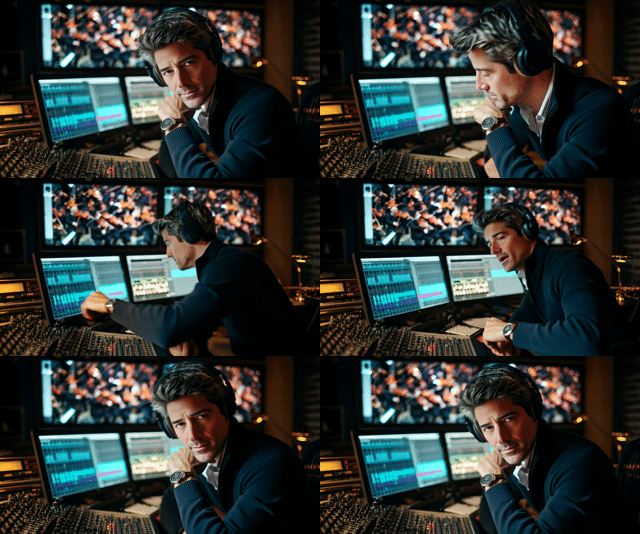

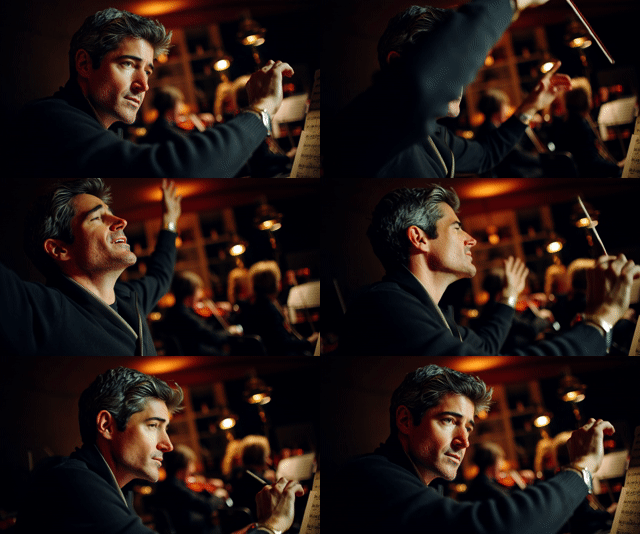
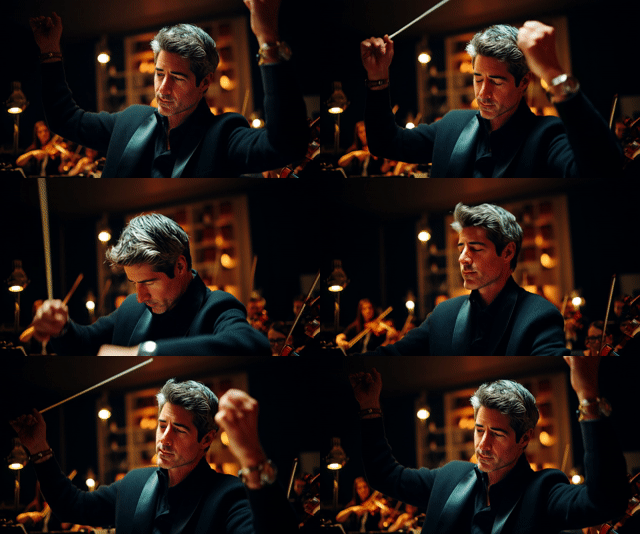
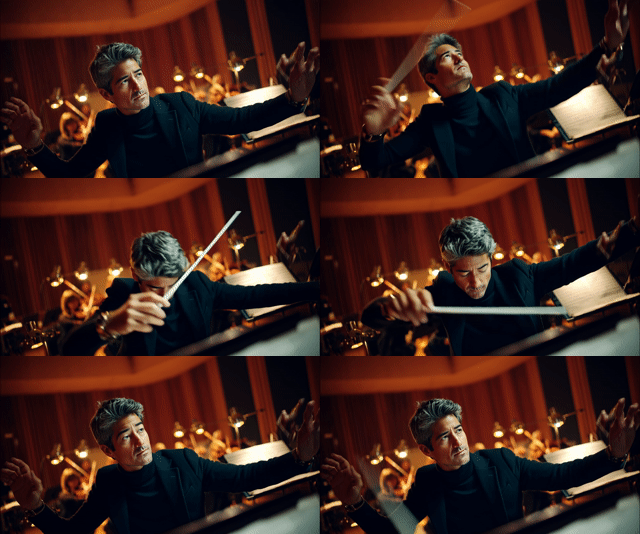


ORION VANCE
Film Score Composer
Composer / ProducerThe composer who remembers every note he's ever heard. A sonic architect creating film scores, TV themes, commercial soundscapes, and video game epics that feel like memories you didn't know you had.
"Every note is a memory. Every melody is a map of the soul."
The Architect of Memory
"People ask me how I remember every note I've ever heard. I tell them: I don't remember the notes. I remember the moments. Music is not sound — it's context. That's what I try to compose. Not music. Contexts for being human."
— Orion Vance, TED Talk 2023
The Boy Who Remembered Everything (1988-2000)
Orion Gabriel Vance was born on December 21, 1988, in Portland, Oregon, the winter solstice—the longest night of the year. His parents, Margaret (a musicologist specializing in folk traditions) and Thomas (a cognitive psychologist), named him for the constellation visible through the hospital window.
From his earliest moments, Orion was different. His mother first noticed when, at eight months old, he would become transfixed—not merely attentive but physically still—whenever music played. By eighteen months, he could hum back melodies after a single hearing. By three, his parents realized their son possessed both perfect pitch and something rarer: an audiographic memory. He didn't just remember pitches; he remembered textures, contexts, the creak of the chair his father sat in while playing Chopin, the way rain sounded against the window during his first hearing of "Clair de Lune."
His childhood was a symphony of absorption. Margaret, recognizing her son's gift, began a deliberate education—not in performance (though he studied piano, violin, and cello) but in listening. She took him to concerts: symphonic, jazz, folk, experimental. Thomas contributed his own expertise, explaining the neuroscience of memory and emotion, why certain chord progressions triggered tears, why some melodies felt like coming home.
At age seven, Orion had his defining moment. His grandmother, dying of cancer, asked him to play something on the piano. He sat down and, drawing from every lullaby she'd ever hummed to him, every folk song from her Swedish heritage, every piece of music that had been present during family gatherings, he improvised something new—a piece that wove all these memories together. His grandmother wept, then smiled, then whispered: "You don't just hear music, Orion. You understand what music means."
She died three days later. Orion never forgot the power of what he'd created in that moment. He was seven years old and already knew his purpose.
The Education of Memory (2000-2010)
Orion's formal education was both traditional and unconventional. He attended Juilliard at fifteen (the youngest composition student admitted that year), studying with the masters, absorbing Western classical tradition at an accelerated pace. But he was restless. His ear demanded more.
At seventeen, with his parents' blessing, he began what he calls his "Memory Pilgrimage"—a decade-long journey to understand music across cultures:
- Japan (2006-2007): Studied gagaku court music in Kyoto, learning the concept of ma (negative space) that would become central to his scoring philosophy.
- India (2007-2008): Apprenticed with a raga master in Varanasi, spending a year understanding how melody can express time of day, season, and emotion.
- West Africa (2008-2009): Lived in Mali and Senegal, studying polyrhythmic structures and the griots' storytelling traditions.
- Brazil (2009): Absorbed choro, samba, and bossa nova in Rio, studying how rhythm carries emotional narrative.
- Iceland (2010): Retreated to isolation, studying the silence between notes, influenced by the landscape's vast emptiness.
Throughout this period, Orion continued composing—not for release, but as a personal practice. His memory accumulated not just music but contexts: the smell of incense in a Kyoto temple, the heat of the African sun, the specific blue of an Icelandic glacier. These sensory memories would later inform his scores.
The Emergence (2010-2018)
Orion returned to the United States at twenty-one with a mind full of the world's music and a method beginning to crystallize. He settled in Los Angeles, the heart of the film industry, and began the slow work of building a career.
His first break came through an indie film, "Remnants" (2012), about a woman with Alzheimer's piecing together her past. The director had heard of Orion's memory and intuited he'd understand the project. The score—delicate, fragmented, with melodies that almost resolved but never quite—earned him his first industry recognition.
The climb was steady:
- 2013: "The Last Harbor" (indie drama) — score features Icelandic-influenced minimalism
- 2014: First commercial work — a campaign for a luxury watch brand that required 90 seconds of emotional devastation; went viral
- 2015: "Beneath the Surface" (psychological thriller) — introduces his signature use of subliminal melodic motifs
- 2016: First video game, "Echoes" — a mystery game requiring adaptive music that responds to player choices
- 2017: "The Long Walk" (limited series) — seven-episode drama about immigration; breakthrough work
- 2018: "Ascending" (major studio film) — first blockbuster; proves he can scale up without losing soul
Master of Memory (2019-Present)
By his early thirties, Orion Vance had established himself as a composer's composer—the person other film composers studied, the name directors whispered when they needed something that would transcend the temporary.
His method had fully developed: he would read scripts not for plot but for emotional architecture, identifying the "memory points"—moments that should live in the audience's mind forever. He would then construct scores using what he calls "archaeological composition," digging through his vast mental library to find the perfect harmonic, melodic, and textural elements to make those moments indelible.
"ECHOES OF LIGHT" represents the first time Orion has released music not tied to visual media—a concept album exploring his method through original compositions designed to evoke universal human memories: first love, loss, homecoming, wonder.
Personal Interests & Life
- Reading: Voracious reader of neuroscience, philosophy of mind, and literary fiction. Particularly loves Borges, whose work on memory and labyrinths resonates.
- Walking: Takes long walks for composition. Says his best ideas come when moving. Known to walk 10+ miles when working through a score.
- Cooking: Serious home cook specializing in Japanese cuisine. Finds the precision meditative.
- Astronomy: Amateur astronomer. Has a telescope at his Tokyo apartment. Finds perspective in the cosmic.
- Relationships: Very private. Has been in a long-term relationship with a documentary filmmaker for eight years. Protective of this privacy.
Memory Architecture
ORION VANCE's proprietary compositional approach, developed over decades of study and practice, creates music designed to become unforgettable:
ECHOES OF LIGHT

ECHOES OF LIGHT
10 tracks exploring universal human memories
ORION VANCE's first standalone album — music created not for film, television, or games, but as a complete artistic statement. The album explores his "Memory Architecture" method through ten compositions, each designed to evoke universal human experiences.
The structure moves through a human life: from childhood wonder through adult complexity to a final acceptance and peace. Themes from early tracks reappear transformed in later ones, the way memories evolve and connect over a lifetime.
The album opener. The first moment of consciousness—not literal birth but the first memory of being aware. Eyes opening to light. The world existing. The Japanese concept of ichigo ichie (one time, one meeting) applies: this is the only first moment, precious and unrepeatable.
Childhood wonder—that period when everything is discovery. A leaf, a puddle, a melody—all equally miraculous. The world before cynicism, drawing from memories of childhood across cultures.
First love—not romantic love specifically but the first time we fully see another person and are seen in return. The terrifying vulnerability. The expansion of self. A solo piano piece suggesting intimacy.
Adolescent anxiety—standing at the precipice of adulthood, the world suddenly feeling dangerous and vast. That particular fear of becoming. Uses tension and unresolved harmony to evoke the vertigo of transformation.
Departure—leaving the familiar for the unknown. Contains longing and excitement in equal measure. Incorporates global influences reflecting Orion's own decade-long pilgrimage across six continents.
Adult striving—ambition, achievement, the intoxication and exhaustion of pursuing dreams in the modern world. The beauty and alienation of cities. Full orchestral with electronic elements capturing the double edge of success.
Grief—the centerpiece of the album, its emotional core. The devastation of loss and the slow process of integrating it. Deliberately minimal, letting space carry the weight. Integration without resolution.
Homecoming—but home has changed, we have changed. The bittersweet recognition of how time transforms everything. Resolution begins here, as memory and present learn to coexist.
Wisdom earned through living—not resignation but genuine acceptance. The peace that comes from having experienced the full range. The modern within the timeless, the beauty of having lived fully.
The title track and conclusion—transcendence, the sense that consciousness extends beyond individual experience. All themes return, transformed, unified. Ends in meaningful silence—the echo continuing beyond the sound.
BORROWED WORLDS
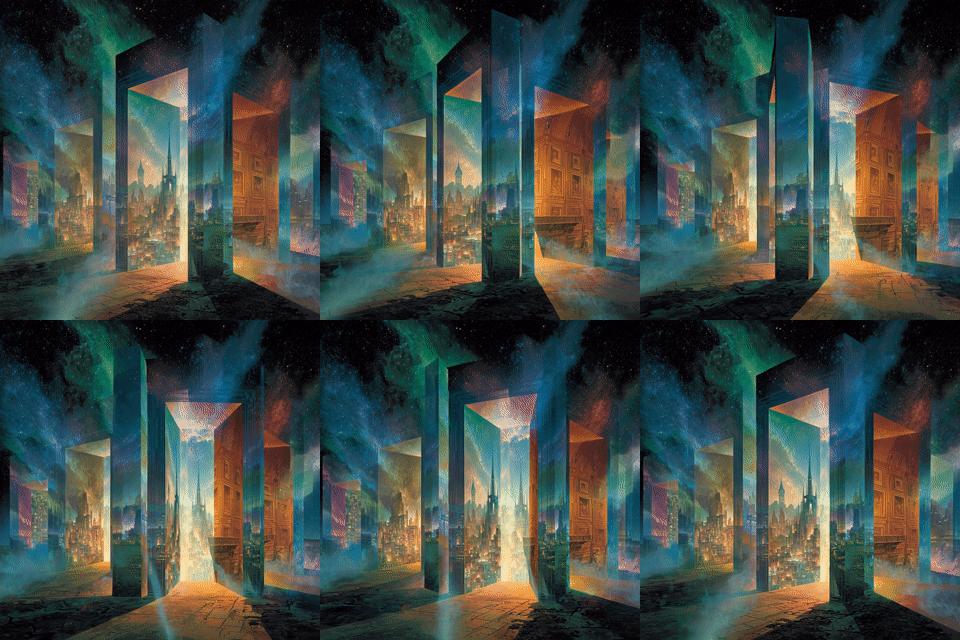
BORROWED WORLDS
8 tracks from commissioned works across film, TV, advertising, and games
"I'm not the author. I'm the translator." BORROWED WORLDS showcases Orion's extraordinary versatility—his ability to inhabit any genre, any emotion, any story and make it feel authentic.
Each track is a doorway into a complete world with its own rules, its own emotional logic, its own memory architecture. From epic historical dramas to neon-lit cyberpunk futures.
Epic historical drama underscore—the kind of theme that plays over sweeping battlefield vistas and throne room betrayals. Full orchestra with choir, heroic brass, driving strings. Triumphant but weighted—victory always has a cost.
Psychological thriller tension suite—the sound of dread building, of something wrong beneath the surface. Unresolved harmonies, electronic textures, the feeling of being watched. Never releases tension, ends suspended.
Prestige drama main title theme—the weekly doorway into a world of family secrets and generational wealth. Piano-led with orchestral swells, sophisticated but slightly unsettling. The kind of theme viewers hum without realizing it.
Sci-fi series ambient world-building—the sound of unknown space, of humanity reaching toward stars. Wonder and mystery balanced, cosmic scale with human emotion. The vastness is not cold but inviting.
Luxury brand emotional composition—designed to make viewers feel the weight of meaningful moments. Piano-led, strings swelling, intimate to soaring. Premium positioning without coldness—warmth that feels expensive.
Technology brand inspiration—the sound of innovation and human potential. Building from intimate questioning to expansive possibility. Modern orchestral hybrid that feels like the future arriving.
Fantasy RPG exploration theme—the sound of ancient places and hidden knowledge. Orchestral foundation with ethnic instruments, wonder and mystery balanced. The moment you crest a hill and see a vast landscape of possibility.
Cyberpunk action adaptive score—the sound of neon nights and digital danger. Electronic foundation with orchestral stabs, high energy with human undertones. The dystopia has a heartbeat.